



The Bigfoot Conspiracy: Hidden Truth or Cultural Myth?
By: Taylynn Conder
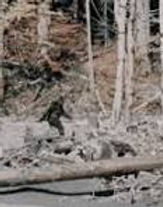
Bigfoot, also known as Sasquatch, is one of the most mysterious and debated figures in American folklore. For decades, people across North America have claimed to witness a massive, ape-like creature hiding deep within the dense forests. Some believe this elusive being is a surviving species of an ancient primate, while others claim it is a myth, hoax, or misidentification. Despite countless stories, blurry photographs, and alleged footprints, the scientific community remains unconvinced. According to Becky Little, “The legend of Bigfoot first began in 1958 when loggers from Northern California discovered huge footprints while working” (Little). A local newspaper published the story as a lighthearted curiosity, and the term "Bigfoot" quickly gained traction. What began as a regional phenomenon soon spread across the United States, and by the 1970s, Bigfoot had become a national obsession. The debate over Bigfoot’s existence continues to divide believers and skeptics, raising the question: Is Bigfoot a genuine undiscovered species or simply a legend fueled by imagination and folklore?
Although many dismiss Bigfoot as a myth or a hoax, some people remain convinced that Bigfoot is a living, undiscovered species that has avoided scientific identification. Stories describe Bigfoot's demeanor as shifting between caution and curiosity. Stories tell of him moving through the forest like a barely contained storm, with snapping of trees and low growls. Yet with his quiet grace and the way he slips away when seen, is he aggressive or shy? Early depictions often presented the creature as wild and dangerous, but by the 1980s, through popular culture its image softened through popular films such as “Harry and the Hendersons”. Robert Wall describes Bigfoot as “a nonaggressive animal, whose shyness and humanlike intelligence make it elusive and thus rarely seen” (Walls). Personal accounts often tell of Bigfoot quietly observing humans from afar, retreating into the forest when noticed rather than attacking or confronting anyone. Although some of the accounts often tell of foul odors or eerie screams, there is no credible evidence of Bigfoot attacking humans. Stories instead describe intimidating, but nonviolent behaviors such as rock throwing, tree shaking, and low growls, or twisted hardwood trees. Only a few known animal species are capable of such feats. Whatever it is, it appears to be an extremely strong creature, one capable of inflicting serious harm if it chooses so. These details suggest that if Bigfoot exists, its behavior may reflect territorial defense rather than aggression. Therefore, Bigfoot may not be the terrifying monster of folklore, but rather a peaceful guardian of the wilderness who simply wants to stay at peace.
Descriptions of Bigfoot remain remarkably consistent across decades and regions. The creature is consistently described as standing between 7 and 10 feet tall, covered in thick hair, and leaving enormous footprints that helped inspire its name. These traits have become so culturally universal that the word “Bigfoot” immediately evokes the image of a huge, hairy, ape-like creature that walks on two feet. Bigfoot is believed to be about 4 times taller than a human and more than likely taller than an Alaskan Brown Bear. According to foot casts, his feet alone would engulf those of an average human. Physical evidence, particularly footprints, plays a major role in sustaining belief. Wolf H. Fahrenbach notes that “footprints are the standard stock in trade of Sasquatch research, and their sometimes inhuman length assures almost immediate measurement, even by first-time witnesses” (Fahrenbach). “The mean length of 702 prints (collected over nearly 50 years) is 15.6″ with a range of 4″ to 27″, and a mean width of about 0.45 times that of the length” (Sasquatch, A.). Whether a soft or aggressive demeanor, with footprints bigger and standing taller than any man, Bigfoot's unforgettable characteristics continue to fuel a legend that refuses to fade.
Despite countless stories and reported encounters, the existence of Bigfoot remains one of the most debated mysteries in modern times. “Sightings of a furry, upright biped and reports of beastly footprints have been reported from as far afield as the Himalayas” (Kent). Blurry photos or grainy videos showing a tall, shadowy figure moving through the wilderness have been captured to provide proof. However, scientists like Emily Mills argue that “there is no physical evidence, no bones, no DNA, and no verified proof that such a creature exists” (Mills). This divide between belief and skepticism has fueled decades of argument, leaving the question wide open: is Bigfoot a real, undiscovered species or simply a legend born from imagination and fear of the unknown? Following are tales of sightings and claims that compare with what the scientific community is saying.
Eyewitness accounts contribute to the legend’s persistence. Margo Margaritoff writes that “the Patterson-Gimlin film of 1967 arguably cemented Bigfoot into American folklore more than any other sighting in history” (Margaritoff). Reports of sightings have emerged from nearly every U.S. state, with over 23,000 alleged encounters on record .In the mountains of Southeastern Oklahoma, around Bokchito, there is said to be a cave where he lives. People have tried to track the cave and find him, but not one person has yet seen him or his cave. Personal family members tell stories of footprints being discovered not only by adults but also by children. These people give firsthand accounts of disturbances and encounters with the creature. A well-known story is told of them living in a trailer at the bottom of the mountain. “In the middle of the night, they heard a loud bang on the side of the trailer. They get up to check, and suddenly, another bang, then the trailer starts rocking back and forth. They composed themselves after the rocking stopped and checked outside to see what had caused the commotion. There was nothing detected that could be responsible for the violence. The only thing left behind was massive footprints outside the trailer and a lot of dark brown hair stuck to the siding” (Uncle Scott).
Cousins tell another story of them riding in the back of a pickup truck on the backroads from Bokchito to Bennington. “One of them dared the other one to holler out Bigfoot's name. The child who was dared screamed, “Bigfoot,” and suddenly something started running through the woods beside them, keeping up with the truck. They were so scared that they lay down flat in the back of the truck until they got home, because they were afraid of what they might see if they looked” (Colby). In Georgia, a man tells the story of his family driving to Florida when a figure stepped out of the woods and crossed the interstate he was traveling. He described the figure as around 7ft tall and covered in black hair except for on the hands, feet, and face. He continues to say that the figure was so close to him that he thought he was going to hit it, but it crossed the entire interstate in about five steps and retreated into the woods. In Illinois, a man tells of a large 8-9ft creature with yellow glowing eyes, covered in brown fur, standing on the side of the road. The creature was attempting to cross, but noticed the truck driver and yielded before retreating.
People who believe are constantly trying to prove of Bigfoot’s true existence. “Investigator Jimmy Chilcutt of the Conroe Police Department in Texas, specializes in finger- and footprints. He has analyzed the more than 150 casts of Bigfoot prints that Meldrum, the Idaho State professor, keeps in a laboratory. Chilcutt says one footprint found in 1987 in Walla Walla, Washington, has convinced him that Bigfoot is real” (NG). While skeptics dismiss these tales as misidentifications or hoaxes, those who have experienced them firsthand remain convinced that something extraordinary roams the forests of North America.
For every story and account claiming Bigfoot's existence, there are just as many people and non-believers who oppose it. Scientists remain largely skeptical about the existence of Bigfoot because there is no concrete scientific evidence to support the creature's reality. According to Emily Mills, “Mark Wilson, a geology and natural sciences professor at the College of Wooster, led the presentation, titled "A Scientific Perspective on Bigfoot," to explain that scientists do not believe it's likely the creature truly exists” (Mills). He goes on to say that the footprints, DNA, photographs, and videos have all been manioulated and hold no real truth or evidence. Decades of research, wildlife surveys, and DNA testing have failed to uncover any biological trace of an unknown primate species living in North America. Every alleged hair, bone, or tissue sample claimed to be from Bigfoot has been proven to belong to known animals such as bears, deer, or humans. He further explains that for the scientific community to acknowledge that Bigfoot is most definitely real, real biological proof is needed, such as bodies, bones, or skin. Without these pieces of evidence, Bigfoot is just a made-up legend. All skeptics demand solid proof. “Some skeptics offer psychological and sociocultural explanations for Bigfoot sightings. They suggest that the human brain is wired to recognize patterns and faces, sometimes leading to misidentifications of bears, large animals, or even tree stumps, such as Bigfoot” (SSST). As technology advances, the skepticism builds even more. With access to trail cams, drones, and satellite imaging, the argument is that there is no undisputable proof of Bigfoot's existence. “These technological tools provide new hope for those seeking definitive evidence of Bigfoot's existence” (SSST). Scientists argue that the use of these technological advances makes it increasingly unlikely that a giant primate could remain hidden. Scientists point out that if a species as large as Bigfoot truly existed, there would be consistent physical remains, clear photos, and a breeding population. Bigfoot would need enough of a population to avoid inbreeding and extinction. There would need to be several hundred to several thousand for this to happen. With a creature this large, there would be definitive signs of existence. The complete absence of this evidence strongly supports the conclusion that Bigfoot is a myth, rather than a real creature. To them, the legend is more a product of folklore, mistaken identity, and human fascination with the unknown than of genuine biological discovery.
The enduring debate and controversy over Bigfoot reflect a broader tension between folklore and scientific inquiry. Despite decades of eyewitness reports, footprint casts, and alleged encounters, no verifiable biological or physical evidence has been produced to confirm the creature’s existence. People with encounters and personal accounts of Bigfoot will share their stories and argue that it is a living creature that seeks its own peace and keeps to itself. Supporters will continue to argue that the consistency of descriptions and the persistence of sightings suggest that Bigfoot may be a yet undiscovered species. At the same time, skeptics maintain that the phenomenon is better explained as misidentification and cultural mythmaking. The absence of concrete evidence, such as bones, DNA, or verified photographs, continues to reinforce the scientific consensus that Bigfoot is a product of legend rather than zoological reality. Nevertheless, the legend’s persistence demonstrates its cultural significance, revealing humanity’s enduring fascination with mystery and the unknown. Whether viewed as an unsolved natural phenomenon or a powerful symbol within American folklore, Bigfoot remains a testament to the limits of human belief, imagination, and scientific proof. Whether Bigfoot stays a legend or is one day scientifically proven, one thing is certain: Bigfoot isn’t going away and will stay a part of American culture for the foreseeable future.
Works Cited
S Fahrenbach, Wolf H. “Sasquatch: Size, Scaling and Statistics”. https://www.bfro.net/REF/THEORIES/WHF/FahrenbachArticle.htm 1997-1998.
S Kent, Lauren. “The 10 Most Convincing Bigfoot Sightings.” 29 October 2025 https://www.outsideonline.com/outdoor-adventure/exploration-survival/10-convincing- bigfoot-sightings/.
S Little, Becky. “How the Bigfoot legend began”. 30 July 2018. History.com/articles/bigfoot- legend-newspaper
S Margaritoff, Marco. “8 Unnerving Bigfoot Stories That Will Make Believers Out Of Skeptics”. 24 October 2024 https://allthatsinteresting.com/bigfoot-sightings
S Mills, Emily. “Science professor explains why Bigfoot's likely not real.” 17 April 2017 Mansfieldnewsjournal.com.
S National Geographic. “Forensic Expert Says Bigfoot Is Real”. 23 October 2003 https://www.nationalgeographic.com/culture/article/forensic-expert-says-bigfoot-is-real
S Sasquatch, Alberta. “Anatomy.” 5 March 2018 https://sasquatchalberta.com/articles/anatomy/
S “Southern Style Sweet Tees”. Skeptics VS. Believers: The Debate over Bigfoot’s Existence, 2025 https://www.southernstylesweettees.com/blog/skeptics-vs-believers-the-debate-over- bigfoots-existence
S Walls, Robert. “Bigfoot (Sasquatch) Legend”. 7 Sept 2022, Pg. 1 Oregonencyclopedia.org
S Wilson, T.A.. “Bigfoot Estimated Height Charts”. T.A. Wilson Bigfoot Research 2016-2020 Pg. 1


